ChristmasArt

Maxfield Parrish - Daybreak

Inspired by - Maxfield Parrish  - Daybreak

Daybreak was commissioned in 1920 for the sole purpose of reproduction. It was distributed to the American public as a color lithographic print. It went on to be the most reproduced painting in American history. One 1925 survey estimated that as many as one in every four American households had a "Daybreak" print on its wall. The naked figure in "Daybreak" is Parrish's eleven-year-old daughter Jean. The reclining figure is Kitty Owen Spence, the eighteen-year-old granddaughter of William Jennings Bryan. Bryan was a three-time presidential candidate for the Democratic party. He bought the original, and it was held by his family until 1974. In preliminary drawings, there was third character. The model for which was Susan Lewin, Maxfield’s housekeeper and lover. Before the painting was released, daughter Jean asked that Lewin be removed.

On May 25, 2006, Daybreak was purchased by Mel Gibson's wife, Robyn at auction at Christie's for $7.6 million. This set a record price for a Parrish painting. When they divorced three years later, it was sold again, but this time for $5.2 million. 

See original painting:  https://bit.ly/4qOOhDS
The Dance

Inspired by Henri Matisse - The Dance

The Dance was commissioned by a Russian businessman and art collector Sergei Shchukin, with whom Matisse had a long association. This painting hung together with Matisse’ Music on the staircase of Shchukin's Moscow mansion. A year after the Russian Revolution his house and collection was confiscated via a decree signed by Lenin. His home then became the State Museum of New Western Art. In 1948, Stalin signed the decree which closed it down because of its “bourgeois artwork”. The contents were then split between the Pushkin Museum of Fine Arts and the Hermitage Museum.

A second Dance was commissioned by a businessman and art collector Albert Barnes with whom Matisse also had a long association. It hung above the windows in the main gallery of his home (which housed 24 other Matisse paintings). After a lengthy lawsuit following his death, the Barnes Foundation collection was appropriated by the city of Philadelphia, and relocated to the Parkway near the Philadelphia Museum of Art.

A third version (which was a study for the first) was acquired by Nelson Rockefeller, a businessman and art collector, and donated to the MOMA. I guess businessmen just “Wanna Dance”.

To see original: https://bit.ly/4tG2yp8

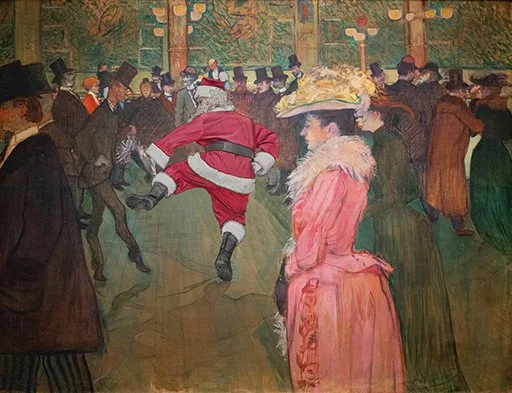
Henri de Toulouse-Lautrec - At the Moulin Rouge-

Inspired by: Henri de Toulouse-Lautrec

A penciled inscription, in the artist's hand, on the back of this famous painting reads: "The instruction of the new ones by Valentine the Boneless." A nickname given a nimble dancer who instructed the Moulin Rouge rookies in the can-can. Many of the inhabitants of the scene are well-known members of Lautrec's demimonde of prostitutes and artists. At the far right the Irish poet William Butler Yeats leans on the bar. The owner of the Moulin Rouge liked the painting so much he hung it over the bar.

Lautrec was born with serious congenital health condition which could be attributed to aristocratic inbreeding. Even his parents, the Comte and Comtesse, were first cousins. At the age of thirteen, Henri fractured both his femurs. Neither of the breaks healed properly, because of a brittle bone genetic disorder called pycnodysostosis (try and pronounce that!) which is frequently called Toulouse-Lautrec syndrome today. The injuries permanently halted the growth of his legs causing him to develop a full adult torso, while his legs remained child sized.

Lautrec popularized the cocktail. He was known for getting drunk off “earthquake cocktails”, which were a strong mixture of absinthe and cognac. He even hollowed out his cane, so that he could fill it with liquor. One of his drinking buddies was van Gogh, who he painted sipping a glass of absinthe. One evening the two were so drunk that Lautrec challenged an equally drunken Belgian to a dual after he desrespected his Netherlandish friend. To see original: https://bit.ly/4pr4Kh2

The Life Line

Inspired by: Winslow Homer - The Life Line – 1884

In 1881 Homer spent a year in the coastal town of Cullercoats, England. A fishing village, and an artist’s colony, which attracted painters to its beautiful landscapes and the sea. There he witnessed the life brigade rescue of a floundering ship. It was the essence of man against the sea, the driving force of his early marine paintings.

Two years later, in Atlantic City, new Jersey, he saw a demonstration of the breeches buoy, a recent innovation in lifesaving technology. Secured firmly to ship and shore, the device permitted the transfer of stranded passengers. The following year he painted The Life Line, one of several he did at that time on the rescue theme. In 1866, the apparatus was first used when the brigantine Tenterden, escaping a hurricane, floundered at the mouth of the Tyne in England. The local life brigade rescued the crew along with the Captain’s wife and child. Could this be the wife?

To see original: https://bit.ly/3JzEHVW https://bit.ly/3JzEHVW

Pieter Bruegel the Elder - The Peasant Wedding

Inspired by Pieter Bruegel the Elder - The Peasant Wedding

Brueghel was well known for his peasant scenes; he was often referred to as ‘Peasant’ Breughel. Through his paintings we came to learn more about village life of the 16th century. Like so many other moralistic genre paintings this is filled with symbolistic references. Here gluttony and poverty stand out, but possibly lack of virginity. The paper crown hung over the bride is in two parts which implies she may already be with child.

Pieter’s son, Brueghel the Younger made a copy of his father’s work, and a couple mysteries appear.  In the elders version, there is an additional foot under the food tray (a door off its hinges). It seems the man in the front of the tray has three feet.

Is this a joke by the painter? Clearly Brueghel the Younger, didn’t think it was funny for in his painting the third foot is eliminated altogether. Another object that went missing is a large codpiece (a leather phallus sheath, cod was slang for scrotum) on the bagpiper. The younger attached this accoutrement to the bagpiper, but Dad’s has gone missing. Through infrared photography they found that senior’s codpiece had been replaced with a black patch. This was not the first time the elder was censored. In his bawdy, The Wedding Dance, several codpieces were removed from the frolicking peasants, only to be discovered during a 1941 restoration. I guess Pieter was not the only one with scruples

See Original: https://bit.ly/3r0aLbF

Sandro Botticelli - Primavera

Inspired by: Sandro Botticelli , Primavera

Many believe this painting was commissioned by Medicis as a gift on the occasion of a family wedding. Though the ceremony took place in July, the nuptial was originally scheduled for May, making spring an appropriate subject matter. In the painting, nine mythological figures appear in an orange grove (a reference to the Medicis). All around them, sprout hundreds of flowers in bloom. There are almost 500 blossoms, representing about 200 different species of which 130 have been specifically identified. The characters in the painting are intended to be identified in order from right to left to suggest the progression of the Spring season. Zephyrus god of March, followed by Venus, the goddess of April, and Mercury, the god of May. Mercury uses his caduceus to disperse the wisps of clouds in preparation for the oncoming summer. The caduceus is Mercury’s magic wand entwined by two serpents. It became a symbol of the medical profession. To see original: https://bit.ly/2FC6z83

Caspar David Friederich - Wanderer Above the Sea of Fog

Inspired by Caspar David Friederich - Wanderer Above the Sea of Fog

If you Google Romantcism this painting is one of the first that will appear in the images. Romanticism was an artistic, literary, musical, and intellectual movement that originated in Europe, and was in its peak in the early 1800’s. Standing on a high dark rock, while foggy mist swarms over the distant valleys and mountains beyond, a lone figure contemplates his place in the universe,

At the age of 13 Kasper was skating on the Baltic with his brother. He fell through the ice, and hisis brother came to his rescue. Caspar lived but his brother died. This emotional experience haunted him for most of life. He attempted suicide in his adulthood. It may be the reason for the somber feeling in his early paintings. He painted the Wanderer at the age 34. That was also the year he married Caroline Baumar. After his marriage, his paintings became lighter, adding more color and people. Although his people were usually looking away from the painter.

To see original - https://bit.ly/3Q5qn4u

Edgar Degas - Waiting

Inspired by Edgar Degas - Waiting

Hilaire-Germain-Edgar Degas affected disdain toward the improvised outdoor landscape studies for which many of the Impressionists became known. He clung to the habit of drawing on location in preparation for his pictures and insisted on finishing in the studio routinely with models. Degas considered himself a Realist painter. He attempted to paint things as they were, versus how he perceived them to be. Still, the art world considers him an Impressionist artist as he adopted their loose strokes and play on light.
Degas and the ballet are virtually synonymous. Dancers, shown in every phase of their complex and demanding art form, make up more than fifty percent of his abundant output. He created approximately 1,500 paintings, monotypes and drawings.
He was aware, from an early point in his studies, of the exhaustion of the ballerinas, and the extent to which they pushed the limits of their bodies. He was further conscious of the brevity of a dancer’s career. Here the chaperone’s face still displays youthful features, yet she is more than likely an ex-dancer. The younger woman represents what her forlorn looking companion once was.

To see original: bit.ly/3o4o32n